 Jumperexchange
Jumperexchange quotes swap and bridge routes for your chosen destination token and network
Jumperexchange uses the chosen destination to distinguish a same-chain swap from a route that crosses networks. Start with the token you need and the chain where you need it. A swap exchanges tokens on one chain; a bridge moves value between chains. A cross-chain route can include both operations. For a first session, reviewing an executable quote creates a useful stopping point before approval or transaction submission.
· updated
Destination details shared by swap and bridge quotes
Every swap or bridge quote starts with the assets and networks that define the intended outcome. Its input describes the funding asset and amount; its output specifies the destination asset and chain. Matching those details comes before comparing providers, because a favorable quote for the wrong destination cannot satisfy the intended task. A network appearing in a supported list does not establish an executable route for every amount or token.
An ERC-20 token’s network and contract address identify the asset that the route uses. A familiar symbol does not establish that the destination application accepts that token contract. This becomes important when a route can deliver an intermediate asset or a different representation of the desired token. The destination chain and exact output token need to agree with the next intended use.
When is a same-chain swap the right starting point?
A same-chain swap fits when you need a different token on the network that already holds the funds. It changes the asset while keeping settlement within that network. A bridge route serves a different destination chain, and a cross-chain swap also changes the token when the desired asset differs. Moving networks adds the selected bridge or execution provider to the transaction’s dependencies, so remaining on the existing chain avoids an unnecessary cross-chain transfer.
A combined route can swap before bridging or after assets reach the destination. The selected path determines that order from the available liquidity and supported operations. Choosing a swap and a bridge independently means arranging that sequence yourself. An aggregated route coordinates the required operations for one requested outcome, while retaining the limits of its underlying providers.
Gas and value in the route comparison
A route’s expected output describes the destination asset amount, while gas pays for execution. Comparing routes requires keeping those cost categories separate. The sender pays source-chain gas. Bridge providers can collect destination gas costs from the tokens sent through the route. That charge concerns the routed transfer; a later destination-chain transaction may require additional native gas.
An executable quote can change before submission because liquidity, prices or provider availability change.
The returned minimum-output amount sets the bound for the swap; estimated output represents the quote’s expected amount. Increasing slippage tolerance widens the acceptable rate range before the swap fails. That adjustment cannot supply missing gas or fix an incompatible recipient. The routing engine measures price impact from the difference in USD value between input and output tokens. Compare expected output and minimum output against the amount needed for the destination use.
The selected bridge’s settlement latency affects both the quoted arrival estimate and actual cross-chain completion time. Amounts outside the usable range of a bridge or exchange can prevent a quote, even when the chain pair is supported.
Token approval as a separate commitment
Token approval matters when a route needs permission to spend an ERC-20 balance. If the route supplies an approval address, that address identifies the spender requesting permission. Review the spender and permitted amount before granting the allowance. Approval changes a spending permission; it does not deliver the destination asset. Native-token routes do not require an ERC-20 allowance; you still authorize the transaction that moves the funds.
An ERC-20 allowance permits the named spender to transfer tokens up to the approved amount. A later approval can replace the allowance. Leaving a route review does not itself reverse permission that a confirmed approval already granted. The token’s allowance state therefore matters independently of whether the subsequent swap or bridge completes.
The first route review
A first session can end with a reviewed quote, before any spending approval or route submission. The quote should resolve whether the destination requires a token change, a network change or both. Choose the source token, chain and amount for the wallet you intend to use, then request a quote for the destination token and chain.
- Choose a same-chain swap when you need a different token that the next action accepts on the existing network.
- Compare cross-chain routes when the next action requires a different network.
- Require the quoted output token to match the destination application, including its contract where relevant.
- Proceed with ERC-20 approval only when the spender and permitted amount match the reviewed route.
- Stop before approval or submission if the quote, available funds or source-chain gas balance is unsuitable.
Does source confirmation mean a bridge route is complete?
Source confirmation alone does not establish that a cross-chain route has completed. A bridge followed by a destination swap or deposit leaves another action to complete after movement between networks. Final status and the destination’s actual token delivery establish what the route achieved.
A destination operation can fail after the bridge succeeds. In that case, the user can receive the bridged token without the planned destination swap or deposit. The transfer has reached the destination network, while the intended output remains incomplete. Treating that state as a failed bridge would describe the wrong operation. Check which token actually arrived before assuming that the original funds remain on the source chain.
Composer powers Quick Deposit’s execution: supported same-chain actions succeed or revert together, while cross-chain deposits through the routing API settle in separate phases.
The routing system’s PARTIAL substatus records a final transfer outcome in a different token than expected. It is not a countdown toward automatic conversion into the requested asset. A pending status describes unfinished processing instead. Reading the status together with the received token separates waiting for settlement from deciding what to do with an already delivered asset.
A protocol position as the next destination
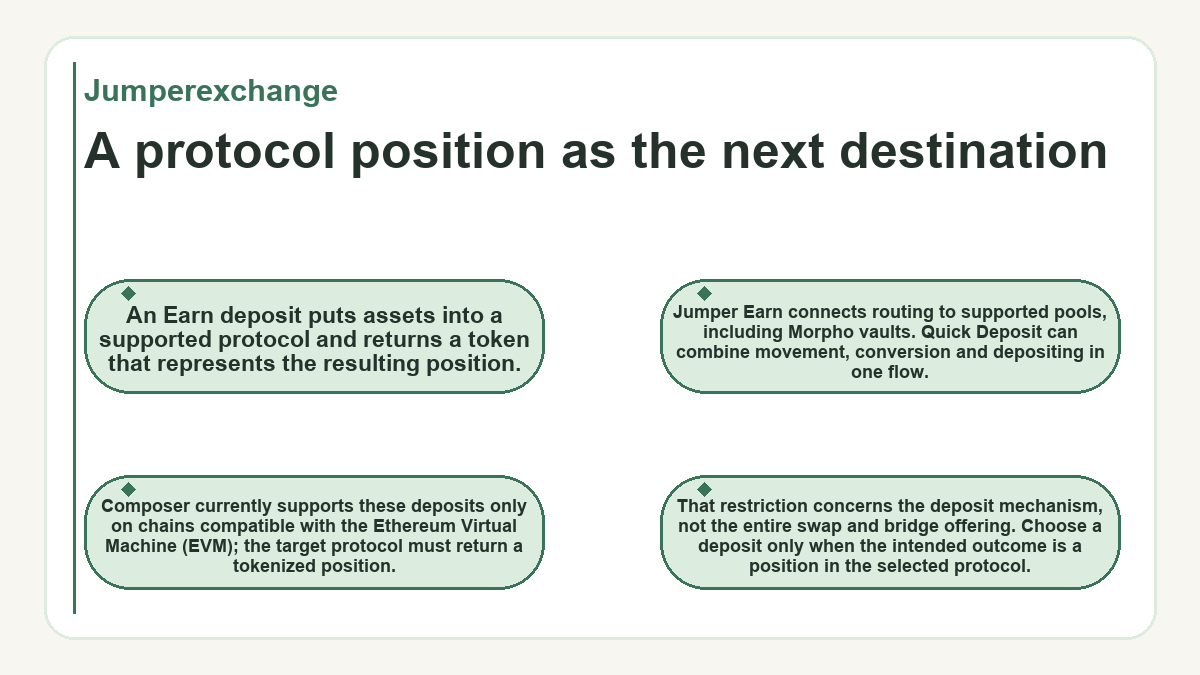
An Earn deposit puts assets into a supported protocol and returns a token that represents the resulting position. Jumper Earn connects routing to supported pools, including Morpho vaults. Quick Deposit can combine movement, conversion and depositing in one flow. Composer currently supports these deposits only on chains compatible with the Ethereum Virtual Machine (EVM); the target protocol must return a tokenized position. That restriction concerns the deposit mechanism, not the entire swap and bridge offering. Choose a deposit only when the intended outcome is a position in the selected protocol.
Jumperexchange - common questions
Which Mayan routes reject EVM smart contract destinations?
The mayanWH and mayanMCTP variants of Mayan do not support EVM smart contract destination addresses. A route that uses either variant can therefore reject that recipient type. Other bridge routes have their own compatibility rules; this restriction does not apply automatically to every route or every smart contract wallet.
When does a Solana wallet need SOL before requesting a bridge quote?
A wallet-specific bridge quote from Solana requires the wallet to hold SOL for rent and gas. The routing API also supports address-free advanced route requests for rate previews. That preview path does not remove the native-token requirements for submitting a real transfer.
Does a failed bridge route always trigger an automatic refund?
Refund behavior depends on the bridge, so a failed route does not always trigger an automatic refund. Some providers refund automatically, while others can leave a transfer unresolved. The recorded provider and final transfer status determine how to interpret the failure; a failure label alone does not show that the original tokens have returned.
What does error code 1001 mean when I request a route?
Error code 1001 usually indicates that the sending address lacks enough funds to cover the transaction. Compare the requested token amount with the available balance and account for required gas. This error concerns generating a usable transaction; it does not, by itself, show that a transfer has already occurred.
Why does ’not an EVM transaction’ appear after my tokens arrive?
The routing service can show that message while it still awaits transaction indexing. Once indexing finishes, the scanner can display the transaction details. The message alone does not establish that the transfer failed, so distinguish a delay in the scanner’s records from the actual outcome on the destination chain.
How does an intent-based route change the execution choice?
An intent describes the desired outcome, such as the destination token and minimum acceptable output, and solvers compete to fulfill it. Intent-based execution can appear alongside conventional exchange and bridge routes in the routing system. Availability follows the route returned for the specific request, so an intent label alone does not establish an executable path.