 Jumperexchange
Jumperexchange slippage tolerance sets the minimum output a swap can accept
Jumperexchange slippage tolerance determines how far a swap’s output may fall below its quoted estimate before the minimum-output check rejects the transaction. Read the returned toAmountMin as the quoted floor. A tighter bound accepts less adverse movement; a wider bound permits a lower amount without improving liquidity.
· updated
Bottom line: A wider tolerance permits a lower output, so compare the returned minimum with the amount your intended use requires.
Reading the minimum in a swap quote
Reviewing a swap quote means comparing its estimated output with the minimum that the quote accepts. Jumper’s routing data separates these values, so a favorable estimate alone does not describe the full range that the transaction permits.
The quote’s output fields
Estimated output
toAmount
is the estimated post-swap amount of the destination token. It describes the quoted outcome using the route’s available pricing. The final amount can differ from this estimate while remaining above the accepted minimum.
Minimum output
The returned
toAmountMin
is the quote’s minimum output amount.
Use this field directly instead of reconstructing the floor from a displayed percentage. Route-specific adjustments can affect the returned amount, so the percentage alone may leave out part of the calculation.
Compare amounts for the same destination token on the same chain. API amounts use the token’s smallest unit, while a wallet normally displays decimal quantities. Matching the token’s decimals makes that comparison meaningful; a similar ticker does not establish matching units.
What changes when tolerance is tighter or wider?
Tighter tolerance makes the minimum-output check reject a smaller unfavorable change; wider tolerance allows a larger change before rejection.
Tighter tolerance
A tighter bound places the minimum closer to the quoted estimate. It can prevent execution at an amount below your required output. Rapid price changes can consequently cause more minimum-output failures. The setting does not improve the rate that available liquidity supplies.
Wider tolerance
A wider bound permits more adverse movement between the quote and execution. That extra room can let a swap proceed through a rate change. It also admits a lower output, which matters when you require a particular amount for the intended use.
Identical percentages can produce different minimum amounts when quotes have different estimates. Compare the returned floors in token units when assessing those quotes. A wider percentage paired with a better estimate need not have the lowest absolute minimum.
Liquidity and trade size behind price impact
Liquidity and requested size affect the quoted exchange outcome before any tolerance change. Liquidity is the pool or market capacity available to fill that trade. Price impact describes the exchange-value difference already reflected in a quote. The routing API calculates price impact from the difference in USD value between input and output tokens. A larger trade relative to available pool liquidity can worsen the quoted outcome. That loss appears in the estimate before you decide how much later movement to accept.
Does a slippage error always call for a wider bound?
A slippage error does not automatically justify a wider bound; refreshing a delayed quote can address a stale estimate. The error’s wording can distinguish a return below the minimum from a changed exchange rate.
Return amount is not enough
means the expected return falls below the minimum accepted threshold.
Exchange rate has changed
signals a price change between quoting and execution. Increasing tolerance permits a broader range of outcomes. It does not restore the earlier exchange rate.
A price-impact warning concerns the quoted exchange outcome. The API’s
maxPriceImpact
parameter can filter routes that exceed an impact limit. Missing liquidity, provider downtime or an amount outside available pool limits can also prevent an executable quote. Raising tolerance does not supply missing liquidity or restart an unavailable provider.
A quote floor against a required amount
For a hypothetical same-chain swap, would either quote protect a requirement of at least 730.04 output units? Both quotes estimate 731.84 units of the same selected output token. Their returned minima are 730.14 under a tighter bound and 728.54 under a wider bound.
The tighter quote’s floor exceeds the reader’s requirement by 0.10 units. The wider quote’s floor falls short by 1.50 units, although both quotes show the same estimate. Only the tighter returned minimum meets the stated acceptance condition.
If the swap would produce 729.24 units, the wider minimum-output check passes by 0.70 units. The tighter check fails by 0.90 units, so that guarded same-chain swap reverts. The wider quote permits an amount 0.80 units below the reader’s requirement, provided the transaction’s other checks pass. Raising the required amount above 730.14 units would make both quoted floors insufficient.
How does a bridge change minimum-output protection?
A cross-chain route can finish its bridge leg even when a destination swap fails its minimum-output check. Same-chain Composer execution on a supported EVM chain can bundle a swap and protocol deposit into one atomic transaction. Atomic execution means every action in that transaction succeeds or the whole transaction reverts.
In the routing API integration, each phase of a cross-chain Composer flow is atomic within its own supported EVM chain. The overall flow settles across separate chains: the source transaction triggers a bridge, then destination actions execute. Bridge latency leaves time for prices or available liquidity to change.
A
PARTIAL
outcome can leave the bridged token in the wallet when the final swap fails. In a cross-chain deposit, a failed destination call can likewise leave bridged tokens instead of the intended position. For Quick Deposit, arrival of that token alone does not establish a completed deposit. A different token’s balance cannot demonstrate that the requested token’s minimum arrived.
Reducing avoidable impact before changing tolerance
Fresh quotes expose changes in rates and liquidity before you change the accepted floor. Refreshing after a delay reduces reliance on stale pricing. It cannot prevent market movement after the new quote.
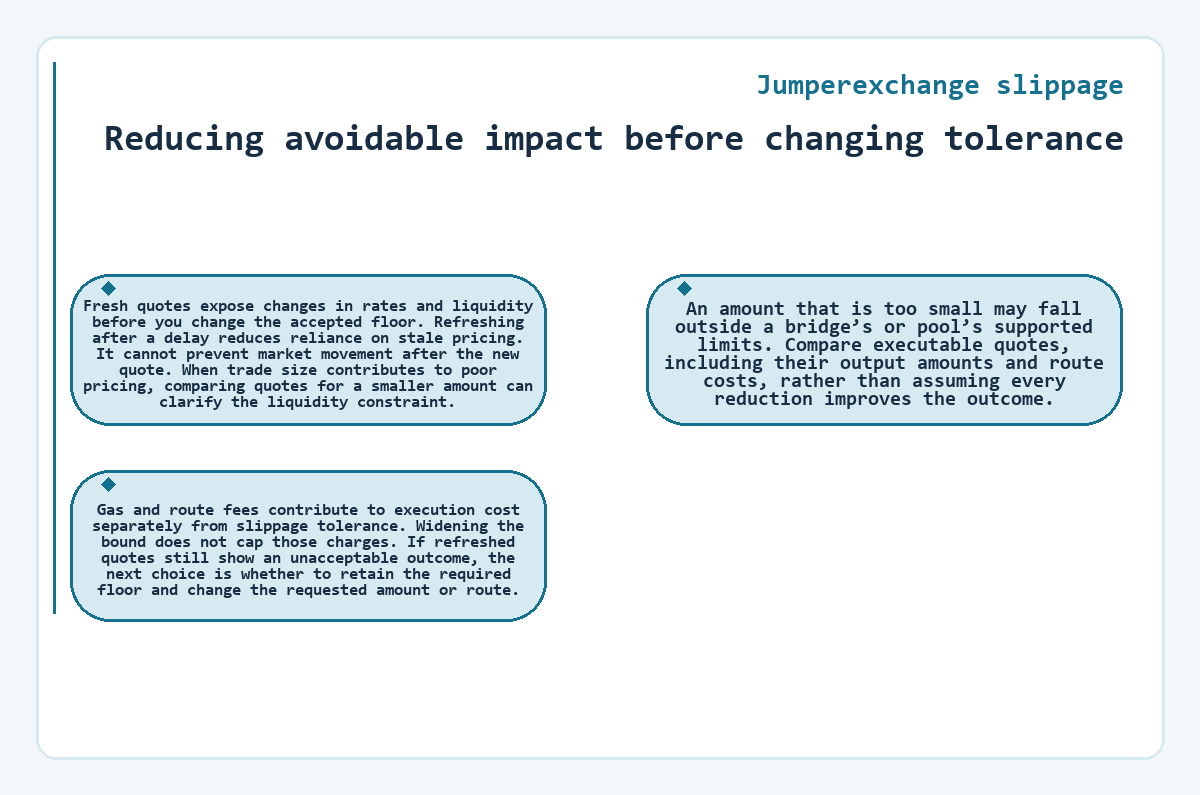
When trade size contributes to poor pricing, comparing quotes for a smaller amount can clarify the liquidity constraint. An amount that is too small may fall outside a bridge’s or pool’s supported limits. Compare executable quotes, including their output amounts and route costs, rather than assuming every reduction improves the outcome.
Gas and route fees contribute to execution cost separately from slippage tolerance. Widening the bound does not cap those charges. If refreshed quotes still show an unacceptable outcome, the next choice is whether to retain the required floor and change the requested amount or route.
Jumperexchange slippage: quick answers
-
Which unit does the API use for the slippage parameter?
- The API expresses slippage as a decimal from 0 to 1, where 1 represents 100%. A value of 0.005 represents 0.5%. This notation describes the parameter’s units; the returned toAmountMin gives the quoted floor after the applicable route adjustments.
-
Why can a multi-step route have several slippage allowances?
- A multi-step route can apply separate slippage allowances to its component steps. Exchanges or bridges can also supply tool-specific allowances. Multiplying a displayed percentage by the number of steps therefore does not reliably reconstruct the final floor. Read the returned minimum for the particular quoted output.
-
Can a transfer-tax token change the quoted minimum?
- Known transfer taxes can affect both toAmount and toAmountMin in the routing quote. For fee-on-transfer tokens below the configured tax limit, the quote may account for known buy or sell taxes alongside slippage. Those adjustments depend on available tax data and do not cover dynamic or undetected taxes.
-
When does Smart Slippage apply to a quote?
- Smart Slippage requires enablement for the integrator requesting the quote. It can select a data-driven server-side default when the request omits slippage. An explicit slippage value takes precedence. It can also return advisory recommendedSlippage values for individual steps. Those values may differ because step-level analysis can inspect intermediate tokens. The feature’s availability alone does not establish that a particular Jumper quote used it.
-
Does price-impact filtering cover swaps below $10?
- The underlying routing API does not apply its price-impact filter to trades below $10. This threshold concerns the filter, not whether a small trade can suffer price impact. Thin liquidity can still produce an unfavorable exchange outcome at a small amount, so the quoted output remains relevant.
-
Does an estimate inside a PENDING status response mean funds arrived?
- An estimate inside a PENDING response does not establish destination delivery. A stored quote records earlier estimates and can appear before settlement. Its toAmount and toAmountMin describe quoted values. The receiving leg records executed output; the pending state alone does not confirm the final amount.
-
Is a missing stored quote evidence that minimum-output checks failed?
- A missing quote object means the status service has no stored quote data for that transfer. Its absence does not change status or substatus and does not establish a minimum-output failure. Comparing the executed receiving amount with the quoted floor requires the original quote and matching destination token units.
-
Can a successful simulation rule out a later slippage failure?
- A successful Composer simulation checks execution against the chain state available at simulation time. Conditions can change before the transaction executes, including extreme cases of aggressive mempool front-running. Simulation also overrides balances and approvals, so its success alone does not establish that the wallet has granted every required allowance.